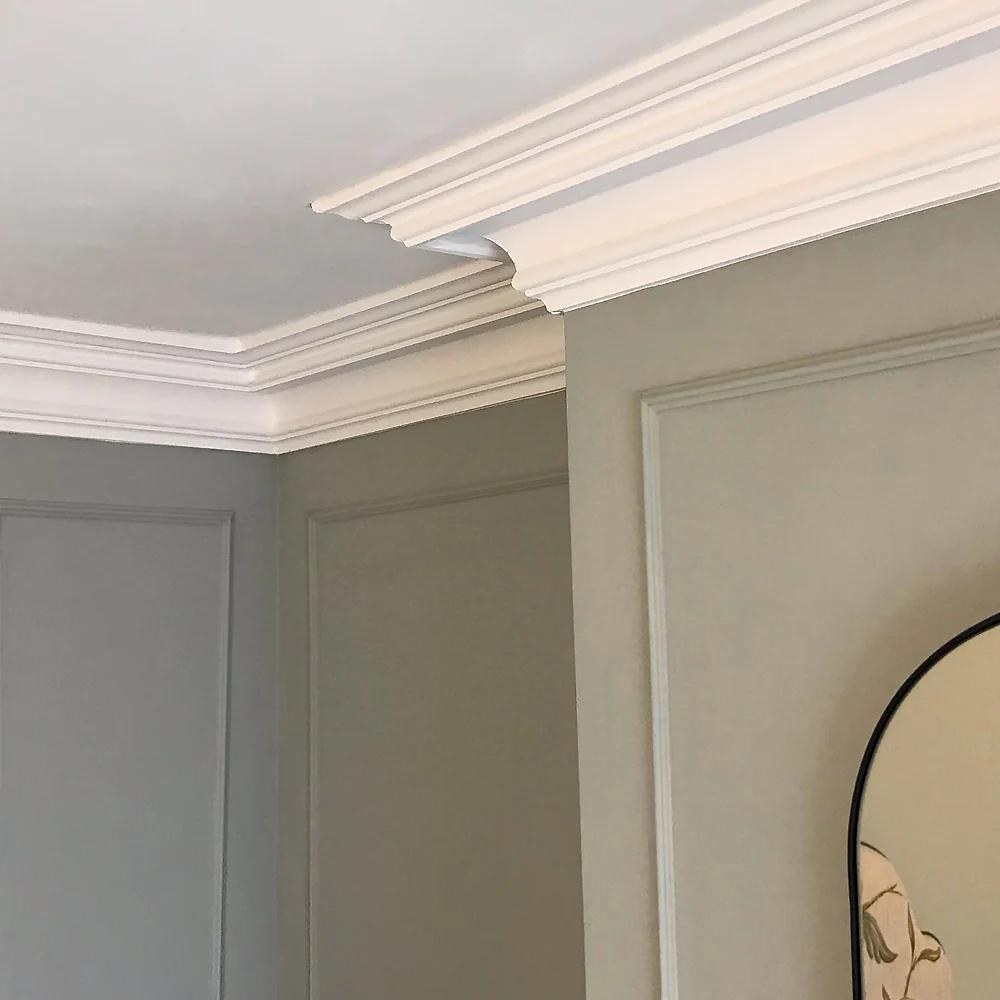
Period detail in a Victorian commuter town
The builders of Haywards Heath's Victorian and Edwardian villas liked their detail. Mid Sussex District Council's appraisal of The Heath conservation area lists the features on the outside alone: modillion cornices, dentil courses, string courses, fretted bargeboards, gauged brick arches, oriel windows, corner towers and ornate timber porches. Houses dressed like that outside were commonly finished to match within, with a plaster cornice where wall met ceiling, a ceiling rose above the light in the main rooms, and sometimes a dado rail in the hall.
Over a century and more, interior plasterwork in houses like these is often lost or damaged. Ceilings come down after leaks and get replaced plain, rooms are divided to make flats, and partitions are run straight through cornices. The appraisal records villas on Oathall Road now split into apartments, and the town's historic assessment notes post-war flats replacing many large villas around the centre. For owners of the villas that survive around Muster Green, Paddockhall Road, Church Road, Heath Road and Oathall Road, putting the cornice back is one of the most effective ways to restore a room's character.
Matching an existing profile
When part of a cornice survives, the aim is a repair you cannot spot. A photo and a measurement of the projection on the ceiling and the drop down the wall help us find a matching or very close fibrous plaster section. Damaged lengths are cut back to sound material, the new section is fixed, and the joints are filled so the run reads as one piece. If the ceiling itself is cracked or uneven, it is put right first so the moulding sits on a straight line; our page on plastering and skimming in Haywards Heath covers that work.
Choosing a moulding for an inter-war or modern home
Not every house in the town is Victorian. Harold Turner's houses of the 1920s and 1930s, Franklands Village from the same decade, the post-war estates and Bolnore Village, where the first homes were completed in 2002, each suit something different:
- a standard 127mm cove for most post-war and modern rooms
- a simple stepped cornice for larger inter-war rooms
- panel mouldings to give plain new-build walls some structure
- ceiling roses, corbels and niches where a feature is wanted
Proportion decides it: a big room with a high ceiling can take a deep profile, while a modest bedroom suits something slimmer. If a ceiling still has a textured finish, it should be plastered flat before any cove or cornice goes up; see Artex ceilings plastered flat in Haywards Heath.
Fibrous plaster features
Beyond cove and cornice, Pro Finish fits friezes, corner blocks, columns, arches, fire surrounds, wall plaques and domes in fibrous plaster. Fibrous plaster is cast around a fibre reinforcement, which keeps pieces light for their size and gives a crisp surface that decorates well, so it works both for restoring a period room and for adding a statement feature to a new one.
Listed buildings
Listed buildings in the town include Rook Cottage and Oat Hall on Oathall Road and the Priory of Our Lady of Good Counsel on Franklynn Road. In a listed building, altering or replacing historic plasterwork can need listed building consent, so talk to Mid Sussex District Council first.
For our full range of mouldings, see coving, cornice and mouldings, or explore everything we do in Haywards Heath. Send a photo of the room or call 07824 165672 for free advice.