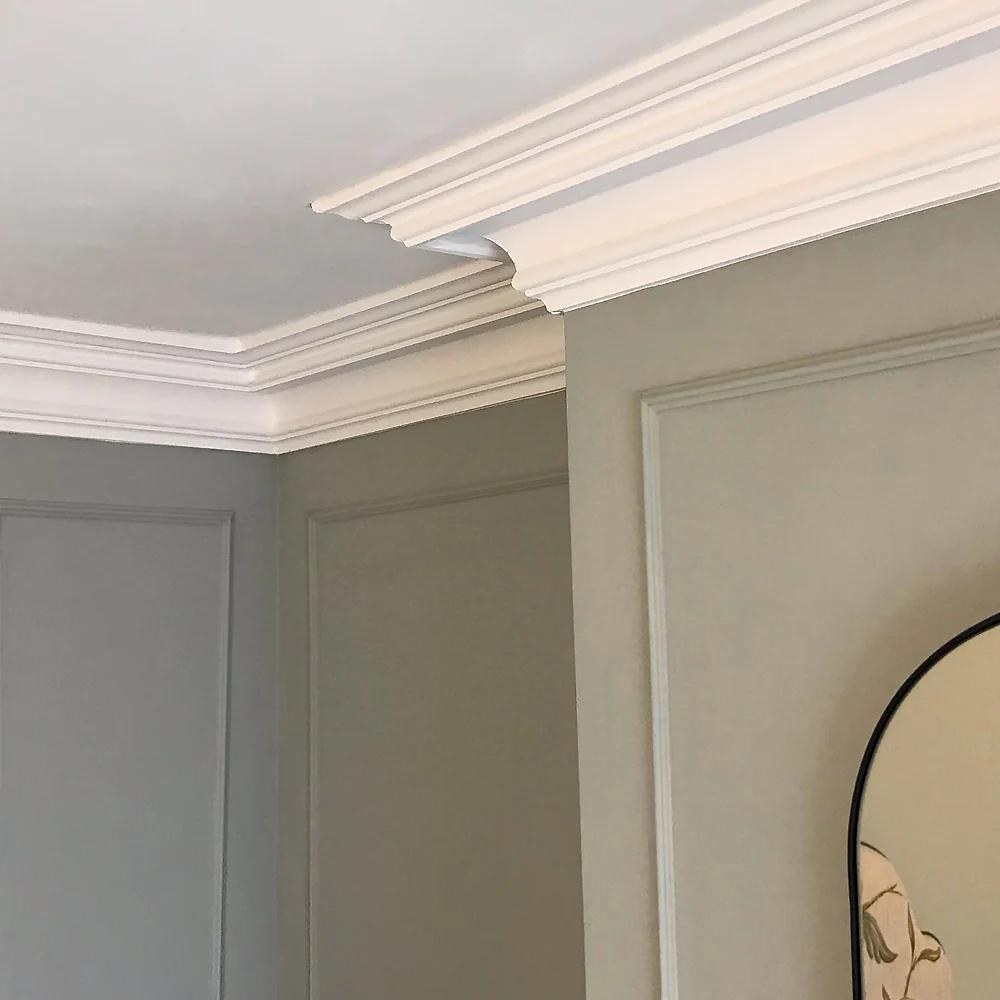
Getting a cornice right in Shoreham-by-Sea is mostly about reading the room. The town's historic core is full of small houses: eighteenth-century cottages in the narrow streets around St Mary de Haura, many of them listed, and two-storey Victorian artisans' terraces of simple design in Queens Place, Ham Road and New Road. On the east side of Southdown Road, by contrast, stand large Victorian houses with bigger rooms and more generous ceilings. Then there are the post-war and modern homes of Shoreham Beach and the roads north of the railway. A moulding that looks perfect in one would look wrong in another.
Small rooms, low ceilings
In an old town cottage or a Victorian terrace, ceilings are often modest in height and rooms are compact. A deep, ornate cornice would crowd them. A slim profile, or a simple ogee or stepped moulding, frames the ceiling without lowering it visually, and a small ceiling rose can finish a central light neatly. Where a cottage ceiling is uneven, the moulding is fixed to follow a straight line along the wall, and the gap above is filled and feathered so the run looks true from the floor. If the ceiling needs work first, see plastering and skimming in Shoreham.
Larger Victorian rooms
The bigger Victorian houses on Southdown Road and elsewhere in town can carry far more. A deeper cornice with enrichment, a matching ceiling rose, and panel mouldings or a dado rail in the hall and stair all suit rooms of that scale. Fibrous plaster, cast plaster strengthened with fibre, is the traditional material for this kind of work, and where some original cornice survives, a matching profile can be sourced or formed from a sample so that a damaged run can be repaired rather than replaced wholesale.
Listed interiors
The Shoreham-by-Sea conservation area contains dozens of listed buildings, most of them Grade II houses and cottages, with the greatest concentration around Church Street and St Mary's Road. Original plasterwork inside a listed building is protected along with the rest of it, so taking down or replacing a historic cornice can need listed building consent from Adur and Worthing Councils, even though the work is indoors. Adding a new moulding where none existed may also be questioned if it would give a false impression of the building's history. It is always worth asking before work starts.
Modern homes and flats
In post-war houses and modern flats, a standard 127mm cove is the usual choice: clean, quick to fit and in proportion with ceilings of that height. Panel mouldings have become a popular way of adding character to plain walls in newer homes, particularly in hallways and bedrooms. If a textured ceiling is putting you off a new cove, flatten it first; see plastering over Artex in Shoreham. Mitres are cut cleanly, joints filled and sanded, and the run is ready for a mist coat and emulsion.
For the full range of profiles, see coving, cornice and mouldings, or the other services we cover in Shoreham-by-Sea. Send a photo of the room or call 07824 165672 for free, no-obligation advice.