A riverside town on a tidal river
Damp in Arundel has more than one source, and the river is the obvious place to start. The Arun at Arundel is tidal; the Environment Agency describes its level there as tidally dominated, meaning the sea is the main factor in how high it runs. The Sussex Extensive Urban Survey places the town at the end of a chalk spur that projects into the river's floodplain, with tidal flat deposits marking the old marshy estuary around it, and the Queen Street area grew up along a causeway across that floodplain.
The Environment Agency's Arundel Tidal Defences Scheme has since added a new flood defence at River Road and Tarrant Wharf and strengthened the river wall along Fitzalan Road, after a section of river wall at River Road failed. Defences reduce the risk of flooding; they do not undo the effects of past flooding, or stop water reaching walls by other routes.
Working out where the moisture is coming from
The same stain can have very different causes, so every job starts with a look at the whole wall, inside and out.
- Rising damp shows as a tide mark and salts low on the wall. In older flint and brick houses, a damp proof course may never have existed, or may be bridged by raised paths, flower beds or render taken down to the ground.
- Penetrating damp comes through the wall: cracked or hollow render, failed pointing, leaking gutters and downpipes. On a solid flint wall, a hard cement render can trap water rather than keep it out.
- Condensation gathers on the coldest surfaces, and the solid outside walls of the old town's cottages are often the coldest surfaces in the house.
- Flood water that has been into a building leaves wet masonry and salts that need time and the right treatment before new plaster goes on.
Cellars and basements
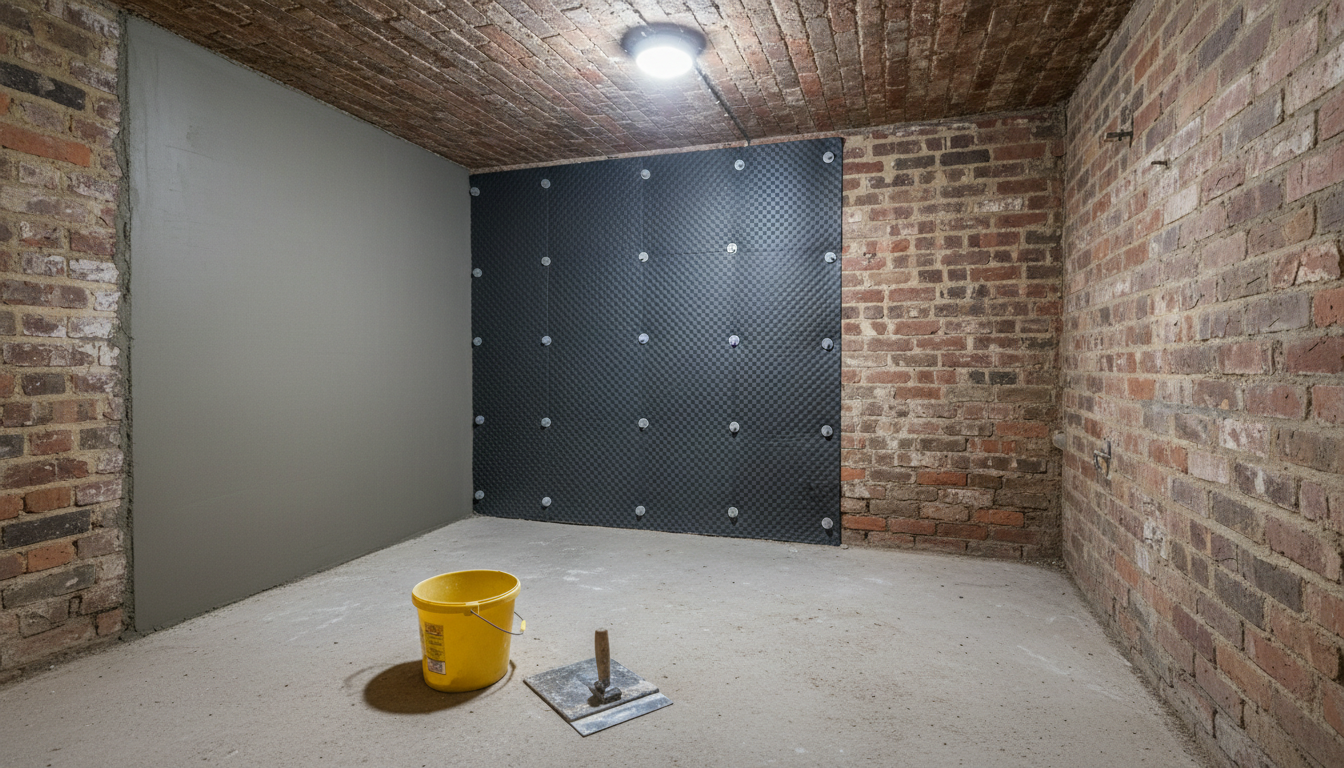
Below-ground rooms are part of Arundel's building history. The Survey records the remains of a chalk-lined cellar found in Tarrant Street, and describes a row of mid-19th-century flint cottages on Maltravers Street built with basements. A wall that holds back soil can never dry from outside, so making a cellar usable means a tanking system on the inside face: either a waterproof render or coating applied to the wall, or a studded cavity drain membrane that lets water drain away behind it while the room stays dry. The wall can then be plastered or dry lined.
Repairs that suit old walls
Once the cause is dealt with, the plaster usually has to be renewed, because old plaster contaminated with salts keeps pulling moisture from the air. On older solid walls the replacement must let the wall breathe, which often means a traditional backing coat rather than a sealed system; our page on float and set in Arundel explains that work. If cracked render outside is letting water in, our Arundel rendering page covers the repairs.
Pro Finish Plastering carries out damp course injections, tanking, mould removal and ventilation work, and the re-plastering afterwards. Read more on our damp proofing and mould prevention page, or see our Arundel page for everything we cover in the town. Call 07824 165672 for free, no-obligation advice.